Welcome to twentytwofifty. This is where I will be posting useful photo information I come across during the semester, things like links to photographers' websites, upcoming exhibitions and events, opportunities to show your work, recommended reading, and much more.

I hope you will check in often. Look, learn, and enjoy!


Monday, October 8, 2012

stefano de luigi . . .


STEFANO DE LUIGI’S IDYSSEY


This past spring, the photographer Stefano De Luigi set out to retrace the Mediterranean voyage of Homer’s Odysseus, armed with only an iPhone to document his travels. In Turkey, Greece, Tunisia, and Italy, De Luigi took Hipstamatic photos, recorded noises from streets and seas, filmed cities and ships, and asked people he met along the way to read excerpts from the Odyssey in their mother tongue.
“The epic has its roots in an oral tradition, transmitted by itinerant poets, singers, and storytellers,” De Luigi writes. “In contemporary society, the digital revolution has drastically changed the transmission of knowledge and information. Everyone can now be a storyteller.” Here’s a glimpse of De Luigi’s 2012 iDyssey.


Read more http://www.newyorker.com/online/blogs/photobooth/2012/09/stefano-de-luigis-idyssey.html#ixzz28iw0Etxy

Saturday, September 22, 2012

nasa self portraits . . .

Curiosity, the recently dispatched Mars rover, took a beautiful photograph of itself earlier this month. Given the great range of terrestrial artists who have documented themselves—Cindy Sherman, Lee Friedlander, Tseng Kwong Chi, Nikki S. Lee—it’s not easy for a humble space rover to distinguish itself in the field of self-portraiture. Here’s a selection of ten NASA self-portraits.


Read more http://www.newyorker.com/online/blogs/photobooth#ixzz27DW30kaU

anne hardy . . .

British artist Anne Hardy constructs life-size sets that are rich in detail using a variety of materials often found in the street or in second-hand shops that hold precise position in her work. In each case, the result of this process is a single photograph, as the installations are then dismantled again. 

"I want to make photographs that create something other than pure reality.”
Anne Hardy interviewed by Elisabeth Krimbacher in Parnass, Issue 3, 2012 


Click here to see and read more about Anne Hardy's work.

Thursday, September 20, 2012

yayoi kusama and joseph cornell . . .


September 18th, 2012 


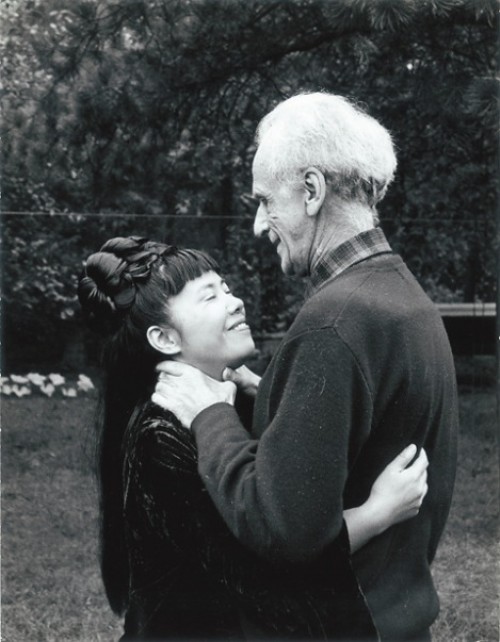
Yayoi Kusama and Joseph Cornell, c. 1971.

The inspiration for this column came from conversations with artists about how ideas develop into finished work. It’s something that has always fascinated me as a fiction writer. The process of making art seems almost alchemical, drawing from yet exceeding our personal history, as there are traces of the transmutation in it, that agent of the unknown, all that’s otherworldly and unpredictable about creating.
As for the known properties, they are often incredibly specific to our lives, the situations and secrets, worries, the people we’ve loved. Preoccupations and details, from the mundane to the exalted. These are, as Louise Bourgeois has it, the stray portions of our consciousness that coalesce into a creative work. As such, we’re typically both authorities and alarmingly ignorant about what’s going on there.
But the human element is often more enormously complex than the few defining details on the wall panel would indicate. In that sense, I hope for this column to be exploratory, interviewing and reviewing, looking at the lives and multiple sources of inspiration for iconic, established, and emerging artists. While acknowledging that art will always exist outside the system of signs and signifiers that we use to navigate the world.
I’ll begin with one of the most talked-about shows in New York this summer—the Yayoi Kusama retrospective at the Whitney Museum of American Art, closing at the end of the month. The Japanese artist, born in 1929, arrived in New York in 1958, where she became part of the ’60s avant-garde, Donald Judd,  Warhol, Claes Oldenburg. She was best known at the time for her naked “body festivals,” which included a lot of ’60s-style orgiastic touching and skin painting in public places. Very much a cultural phenomenon, with many enthusiastic participants, that looks as if it were far more interesting in person than archivally.
The exhibition itself, though, seems framed not by this salacious history, but something even more provocative—for the past thirty years Kusama has been living in a mental hospital in Japan—she does most of her work offsite, in a studio across the road. Her illness is the most lurid detail on the wall panel, and the installation decisions magnify the sense of mental claustrophobia in the work, the rapid, unchecked multiplication of an obsessive mind, and one inhabited by fear. In the show’s final room, the most recent work, a replicating series of tiny faces, eyeglasses, teacups, and footed shoes, sinisterly decontextualized, march across hysterically bright canvases. The outsized paintings are stacked two to three deep, floor to ceiling, so that we, too, are walled in by them.  Then we exit to the elevator.
Kusama readily associates her art with her illness, calling it, in an interview with Bomb, an expression not only of her life, but “particularly of [her] mental disease.” She began having hallucinations at the age of ten. That’s also when she began painting them.
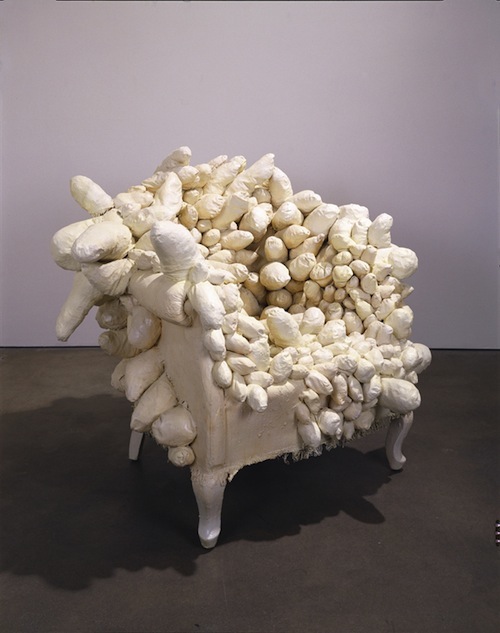
The Sex Obsession and Accumulation series of the mid-60s, some of her most famous work, stems from a sex-fear vision. Composed of the most un-phallic phalluses, these are little warty, benign protuberances that in their sheer proliferation, and stubbornness, become terrifying. They hang off the shoulders of her dress, grow out of her shoes, and handbag. They’re in the kitchen, all over the cooking utensils, on the furniture. As personal as this nightmarish vision is, it may have also sprung from a lived reality. At the time Kusama was fighting to make a name for herself in a Pop Art movement dominated by male artists who would alternately assist, overshadow, obsess over her (see below), and sometimes rip-off her style (Oldenburg, according to Kusama, developed his monumental soft-sculpture work after showing with her at the Green Gallery in ‘62).

Yayoi Kusama (b. 1929). Accumulation, c. 1963. Sewn and stuffed fabric, wood chair frame, paint, 35 1/2 x 38 1/2 x 35 in. (90.2 x 97.8 x 88.9 cm). Whitney Museum of American Art, New York; purchase 2001.342. © Yayoi Kusama. Photograph by Tom Powel.

If the illness does threaten to be a defining inspiration, it is also, in truth, what she’s always made to talk about in interviews. The question is asked and Kusama answers it, offering the internal explanation for an outwardly lived life. Which is why one of the most touching, and telling, parts of the exhibition is the biographical room of letters and clippings and notes, where her obsessive disorder doesn’t seem to have much of a foothold compared to everything else. The standouts there are two charming and intriguing black-and-white photographs of Kusama (looking very lovely) with her once-boyfriend, twenty-five years her senior, artist Joseph Cornell. Cornell, the odd-duck, the loner who lived with his domineering mother in Flushing, Queens, and who spent his days, too many, bickering with her and waiting for the mailman to come. And dreaming—of romance, vanished European cities, long-dead ballerinas. He channeled all that longing into his boxes, creating intricate little worlds the dimensions of thoughts.
Around 1964, Cornell, himself sixty, was looking to try sketching from a live model. The thirty-five-year-old Kusama, an admirer of his, was sent over to pose. There is a strong possibility that this was the first time Cornell had ever seen a naked woman. As Deborah Solomon notes in her biography, the sketches he did that day look as if his hand “was trembling.”
According to Kusama, it was love at first sight for Cornell. But this sort of thing really didn’t bring out his best self, largely because he could never take it to the level of a relationship, or even sex, which he feared more than she did.  A passionate passive, a suitor with no end game, he had all the relentless ardor of someone used to taking it to the next level in his own head. He began tying up the phone line, setting ablaze the mails. On one day he sent her thirteen letters. He successfully set up a barricade of attentions so that “I was just not able to make any other boyfriend,” Kusama said. She wasn’t all that keen on being on the receiving end of someone else’s obsessive behavior. After a while, she says, “I was dying to break it off with him.”
But with Kusama, Cornell would experience his first kiss, touch a woman’s body for the first time, as well as a few other things. Experiences so intensely and gratifyingly sensual, he could only ever talk about them in French. Kusama’s accounts are far less rhapsodic and reveal a lot of frustration. So, was the famous Cornell more of a mentor, an influence on her collage work of the 1970s?  He may have been many things to her, but not that. Kusama actually attributes the influence on collage to flow in the other direction.
This says a lot about her. For all the pathologizing of her source of inspiration, the hallucinations that have plagued her, Kusama was also an incredibly determined and willful and courageous young artist. In her twenties, unknown, she wrote Georgia O’Keeffe a letter from Japan and, after receiving a not-so-encouraging reply, showed up anyway. She did this with little English, even less money, and no support, material or emotional—her horrendously abusive mother used to tear up her paintings. But what overrides the torment in the artwork is pleasure, a sort of visual exuberance, and the tenacity of its creator, who was looking to overturn the American idea of “Japanese girls as delicate hot-house flowers.” Even with all her private turmoil, more than forty years before this Whitney retrospective, Kusama understood herself to be a “human dynamo of creative energy and artistic achievement.”

I welcome thoughts, ideas, show announcements. Please email me at alchemyofinspiration@gmail.com.

NOTES
Louise Bourgeois, Louise Bourgeois: Drawings and Observations (New York: Little, Brown, 1995).
Yayoi Kusama, interview by Grady Turner, Bomb 66 (winter 1999).
I’m very indebted to Deborah Solomon’s fascinating biography on Cornell, Utopia Parkway: The Life and Work of Joseph Cornell (New York: FSG, 1997) for the anecdotes above.

martin roemer . . .

Roemers’s series “Metropolis,” is a documentation of cities with populations over ten million. Roemers created pictures that convey not only the mass and energy of megacities but also the humanity of the individuals living in them. 

Istanbul. A demonstration by socialists and communists passes through Taksim Square, holding up traffic.

Dhaka. Street vendors sell their wares below a pedestrian bridge at dusk with rickshaws passing in the foreground at a busy street market.

Calcutta. A hand-drawn richshaw wallah stands beside an old Ambassador taxi on Madan Street.

Manila. A market in a slum next to Manila’s harbour.

Cairo. A crowd gathers to look at camels being sold in a specialist market in Giza.

Read more http://www.newyorker.com/online/blogs/photobooth#ixzz27147B6TF

Sunday, September 16, 2012

side by side trailer . . .


Side By Side: Trailer


Digital technology has created a groundbreaking evolution in cinema, challenging film as the standard format for motion pictures. In the new documentary Side By Side, Keanu Reeves takes us on a tour of the past and future of the moviemaking process.

edward turner . . .

United Kingdom's National Media Museum revives first-ever film shot in color


In this image released by Britain's National Media Museum on Wednesday, Sept. 12, 2012, a scarlet Macaw on a perch, circa 1902, is depicted amongst the earliest colour moving pictures ever made, which have been rediscovered after more than 100 years. The footage, made by cinematic pioneer Edward Turner in around 1901, was found in the archives of the National Media Museum in Bradford and with the help of experts at the BFI National Archive was transformed into watchable digital files. AP Photo/National Media Museum. 

By: Raphael G. Satter, Associated Press

Click here to read more.

zoe crosher . . .


ZOE CROSHER

PERRY RUBENSTEIN GALLERY

Announces

ZOE CROSHER

The DISAPPEARING of Michelle duBois

September 14 – October 27, 2012

OPENING RECEPTION, THURSDAY, SEPTEMBER 13, 6:00 – 8:00 PM

Photo entitled "Mae Wested no.6 (Crumpled)" by Zoe Crosher, 2012.  Image of woman in large black hat, posing
 “This, in the end, is the artist’s fantasy: that over-exposing, fading, blurring or breaking up an image can be a liberated and liberating act. In Crosher’s presentation, it’s as if duBois’ image has consumed itself and left her, not captive to what the world projects on her or to a fixed self she must uphold, but freely undefined. –Catherine Wagley
Los Angeles, August 20, 2012 — Perry Rubenstein Gallery announces Zoe Crosher: The Disappearing of Michelle duBois, the inaugural fall exhibition in our new Los Angeles gallery.  For her first solo exhibition with the gallery, Crosher will present final works from the Michelle duBois project, aseries of photographic investigations that reimagines and intervenesin the extensive amateur archiveof relentless traveler andself-documentarian, Michelle duBois.  Through this multi-year project, Crosher calls into question our sense of photographic narrative at the end of the analog.  By re-photographing, scanning and re-ordering duBois’ “autoportraits” into a careful amalgam of documentary and the imagined, Crosher blurs the line between fantasy and reality.
Since acquiring the archive of Michelle duBois, Crosher has moved through evolving iterations of exploration, highlighting the strategies and structures of fantasy as much as they expose anything concrete about Ms. duBois herself.  Crosher has created new works that emphasize the impossibility of knowing oneself, even after an endless accumulation of images.  Early approaches often involved the simple act of selecting and grouping images to focus attention on recurring patterns and references.  Later works expansively highlight the archive’s physicality as a relic from the pre-digital era by incorporating images of handwritten notes, photo paper boxes, and film.  The most recent works have featured highly manipulated versions of the original imagery through re-photography and reassembly.  As Crosher has moved through the duBois project, her investigations have resulted in increasingly pronounced interventions leading to the near-disappearance or even total obfuscation of the original source material.  The result is a body of work aiming for complete liberation — from photographic, literary, identity and historic constraint.
Zoe Crosher: The Disappearing of Michelle duBois represents the culmination of the Michelle duBois project and effective dissolution of the archive.  In theAdditive Dust series, the artist has reversed a typical “cleaning up” of photographs by instead accumulating dust from one photograph to the next in 46 steps, completely disappearing the final image.  In the Last Four Days and Nights in Tokyo, prints made from badly damaged negatives depicting duBois posing in an anonymous Japanese love hotel room draw the viewer unusually close before revealing their subject matter.  duBois’ Triple Vision Fantasy Landscapes (Sunset) is evidence of how she merged fantasy and reality during her many travels throughout exotic locales such as Guam.  And, in keeping with Crosher’s interest in creating multiple iterations of the same subject, a new series of crumpled, disappearing nurses perfectly marries two important styles of intervention that have become iconic of the duBois project.
Crosher’s work is currently on view at the Los Angeles County Museum of Art, California through October 14, 2012.  She was recently awarded a solo exhibition at the Dallas Contemporary, Texas, and appeared in the 2010 California Biennial presented at the Orange County Museum of Art, California.  Crosher has been selected to participate in the prestigious Museum of Modern Art’s, New York, New Photography 2012 exhibition on view October 3, 2012 through February 4, 2013, and is represented in major private and public collections.
Zoe Crosher, Mae Wested no.6 (Crumpled ) from the series 21 Ways to Mae Wested, 2012.  Digital C-Print, 36 x 36 inches
© Zoe Crosher
Click here to see more of Zoe Crosher's works.

Saturday, September 15, 2012

richard avedon . . .


The New Yorker magazine as frame . . .

 John Bayley and Iris Murdoch in London, December 1, 1995. For a Life and Letters piece by Ian Hamilton.

Salman Rushdie in London, September 26, 1994.


Toni Morrison in 2003. For a Profile by Hilton Als
.
The New Yorker has been around since 1925, but didn’t publish a single photograph for its first forty-six years. That changed in 1971, when a tiny photo of a bonnet-clad piglet made an appearance on page 64 of the issue of January 30th. Twenty-one more years passed until the magazine took on its first staff photographer: Richard Avedon.
“When Tina Brown brought him to The New Yorker, in 1992,” Adam Gopnik wrote in his 2004 Postscript on Avedon, “she was rupturing a long-standing taboo against photography, and even those who loved his work must have had their doubts. But his photographs, in their epigrammatic compression of a whole subject into a single black-and-white image, were New Yorker profiles in miniature, and within weeks it was as if he had always graced these pages.”
Two years ago, The New Yorker’s embrace of photography expanded to include Photo Booth—the blog you’re looking at now—and today we’re introducing a new design for Photo Booth, including a new fullscreen slide-show function. (Just click on the red arrows arrows3.jpg in the upper right corner.) In celebration of our renovation, here’s a look back at Avedon’s portraits of writers commissioned by The New Yorker, including the portrait of Salman Rushdie that appears in our current issue, alongside Rushdie’s account of his life after the fatwa. “A portrait is not a likeness.” Avedon wrote in his book “In the American West.” “There is no such thing as inaccuracy in a photograph. All photographs are accurate. None of them is the truth.”


Read more http://www.newyorker.com/online/blogs/photobooth#ixzz26ZI4xyfn

Saturday, September 8, 2012

rashid johnson . . .

The New Negro Escapist Social and Athletic Club (Emmett), 2008. Lambda print, 48 ½ x 73 in. (123.2 x 185.4 cm). Edition 1 of 5, aside from 2 artist’s proofs. Collection of Elliot and Kimberly Perry, Memphis.

This September, Miami Art Museum presents Rashid Johnson: Message to Our Folks, the first major solo exhibition for Johnson, a preeminent artist of his generation. Johnson’s practice encompasses photography, sculpture, painting and video and explores diverse questions relating to the self, identity, metaphysics and art, rooted in his individual experience. On view September 7 to November 4, 2012, the exhibition includes more than a decade of Johnson’s work with an emphasis on major works from the last five years. 

"Rashid Johnson’s unusual vocabulary of materials and innovative mixing of diverse forms and cultural references makes him one of the most vital and interesting artists working today," said Tobias Ostrander, MAM chief curator and deputy director. "Johnson’s work has been supported for many years by our collecting community and we are thrilled to present his first museum exhibition in South Florida." 

Throughout his work, Johnson evokes shared memories by referencing icons and figures from American and African-American culture. The exhibition fosters a dialogue by inviting viewers' free associations with familiar figures -- such as W.E.B. Du Bois, Sun Ra, Miles Davis, and Public Enemy -- and everyday objects that appear in Johnson’s work, including plants, mirrors, rugs, record albums, CB radios, shea butter and books. 

Johnson’s conceptually loaded and visually compelling works also allude to alchemy and transformation though his materials and play with the significance and symbolism of different media. His work creates a sense of wonder in the unknown and allows the viewers to draw their own meaning from his works. The exhibition also presents examples from ongoing bodies of work such as Cosmic Slops, abstract paintings made with melted black soap and wax; The New Negro Escapist Social and Athletic Club, portraits of members of a fictional black bourgeois secret society; recent "shelf sculptures" featuring found objects, such as The Shuttle (2010) and Triple Consciousness (2009); and early photographs made using the nineteenth-century Van Dyke Brown printing process. 

Johnson was born in Chicago in 1977 and currently lives in New York. He has a BA in photography from Columbia College and attended graduate school at the School of the Art Institute of Chicago. His work is in the collections of the Museum of Contemporary Art Chicago, Art Institute of Chicago, Whitney Museum of American Art, Seattle Art Museum, Brooklyn Museum of Art, and Detroit Institute of Art. His work has been featured in major group exhibitions including 30 Americans: The Rubell Collection (2008); Only Skin Deep: Changing Visions of the American Self at the International Center of Photography (2003); and Freestyle at the Studio Museum in Harlem (2001); and in 2011 was featured at the International Pavilion of the 54th Venice Biennale. He is one of the nominees for the Guggenheim’s 2012 Hugo Boss Prize, and the winner of the 2012 High Museum’s David C. Driskell prize that honors excellence in African-American art and scholarship.

Wednesday, September 5, 2012

lee friedlander . . .


September 4, 2012

LEE FRIEDLANDER’S NEW YORK CITY MANNEQUINS


This week’s magazine—the Style Issue—includes a spread of images from Lee Friedlander’s recent series called “Mannequin.” From 2009 to 2011, Friedlander photographed shop-window dolls in San Francisco, Los Angeles, Tucson, New Orleans, Newport, New York City, and Washington, D.C. Fraenkel Gallery, in San Francisco, exhibited the work earlier this summer and also published a catalog. This October, Pace/MacGill Gallery will exhibit it here in New York. Here’s a selection of photographs from New York City.


Sunday, September 2, 2012

Tuesday, August 28, 2012

paper-thin lens . . .

Paper-Thin, Distortion-Free Lenses Could Make Pint-Sized Pro Cameras Possible


Using an ultrathin wafer of silicon and gold to focus lightwaves, researchers at the Harvard School of Engineering and Applied Sciences have created a revolutionary new kind of camera lens that completely eliminates the image distortion created by traditional glass lenses. It could not only pave the way for lighter cameras that are still as capable as today's swappable lens models, but even cameraphones that snap images as impressive as a DSLR.

Click here to read more about this new technology.


Friday, August 24, 2012

kodak . . .

Professional photographers still value the unique feel that film gives to their pictures

Debt-struck photography pioneer Kodak says it may sell off its still-camera film and photo paper divisions.
The firm has already stopped making digital cameras as part of efforts to reduce its losses after filing for bankruptcy protection in January.
It has also been trying to raise funds by selling off more than 1,100 digital imaging patents.
It had originally planned to announce a buyer last week, but said "discussions continue" and a deal might not happen.
Apple and Google had been reported to have made rival bids for the patents, but the Wall Street Journal reports they have now joined forces and have added Samsung, LG, HTC and others to their consortium
The WSJ's sources suggested the offer price for the portfolio would be about $500m (£315m) - well below the $2.6bn estimate that Kodak had suggested it could be worth.
The company recently reported a $665m net loss for the first six months of the year, putting further pressure on its finances.
Film's feel
In its latest announcement the US company said it had hired investment bank Lazard to help it sell its Personalised Imaging and Document Imaging businesses.
This would mean an end to it making films for still cameras, photo papers, souvenir photo products at theme parks, scanners and picture print-out kiosks at stores.
It would leave the business focused on printers, cinema film stock and chemicals.
The British Journal of Photography said the news would concern the industry.
"A lot of professionals still shoot with film and like the quality it gives them," Olivier Laurent, news editor at the journal, told the BBC.
"The resolution is still a thousand times higher than most digital cameras can offer so long as a good scanner is used.
"A film photograph has a different mood thanks to its grain - it's about the love of the image and digital still has a hard time trying to reproduce that feeling."


Thursday, August 23, 2012

francois robert . . .


“Everyone at Photographic Works/ArtsEye Gallery, a local Tucson business, loves the Holga—a plastic toy camera that shoots 120mm film. In fact, they love it so much, they host an annual photo competition that attracts photographers from around the world. The exhibit features work shot with Holgas and other curious cameras (pin hole, phones, and then some). The giant camera was originally conceived as a prop for the exhibit that paid homage to the Holga. About halfway through the construction process, it was decided it could be made into a functioning camera. All the dimensions are the same as the toy camera, only 20 times larger (to scale).” The builder of the giant Holga and the owner of the photo lab invited photographer Francois Robert to take photographs with the giant Holga on location. “I scouted around and in Tucson for 2 days making sure each location would have an easy access for the horse trailer and the pick up truck.The most challenging aspect of working with it is actually moving it from site to site. Luckily, the camera fits inside a two-horse trailer, though just barely.” –Francois Robert.
The camera is loaded with photographic paper, either color or black-and-white. It can handle film, but there isn’t any large enough on the market that will fit (30″X30″). Hence, the paper, which comes in rolls and can be used as film. A typical exposure depends on how the paper is rated and the filtration. B&W paper typically needs an exposure of about 1 to 2 minutes, while color paper, without filtration, needs about 1 minute. To learn more, contact Photographic Works (520 327- 7291).


Monday, August 20, 2012

jesse burke . . .


August 20, 2012

JESSE BURKE’S INSTAGRAM TAKEOVER


Last week, the photographer Jesse Burke took The New Yorker’s Instagram feed with him around New England, posting photos from wherever he went: a Vermont wedding, snorkeling on the coast of Rhode Island, and other adventures around his home in Providence with his two beautiful daughters and two odd-looking cats. Burke, an avid Instagram user (follow him at @jesse_burke), is part of a growing contingent of professional photographers using the image-based social-media app as an outlet for their work. “Instagram has been really helpful in making the photo world an even smaller place, which is something I really like about it.” told me. “I’ve gained a lot of new relationships that I may have never made in real life. The Internet makes distance a non-issue.” I asked Burke how his Instagram photos compared with his professional and personal work. “My personal work is very considered and more or less produced,” he said. “I use Instagram in the opposite way. It’s quick and dirty, always on the fly. My personal work is meant to be seen as a collection of photographs that act as pieces to a larger puzzle. I use Instagram as a constant stream of thought that doesn’t end, hopping all around from location to location, thought to thought.”
Burke is the second guest photographer in our new series of Instagram takeovers. (The first was Martin Schoeller.) Here’s a selection of favorites from Burke’s week at the wheel of @newyorkermag.


Read more http://www.newyorker.com/online/blogs/photobooth#ixzz246zrl38g